Buying the wrong industrial crane is an expensive mistake. Undersize it, and you slow down production or overload the equipment. Oversize it, and you pay for capacity and structural support you’ll never use. Since a crane is a long-term investment that’s expensive to change once installed, it’s worth understanding what actually determines the right choice before you finalize an order.
This guide breaks down the main types of industrial cranes, the factors that should drive your decision, and the mistakes worth avoiding along the way.
Why the Right Industrial Crane Choice Matters
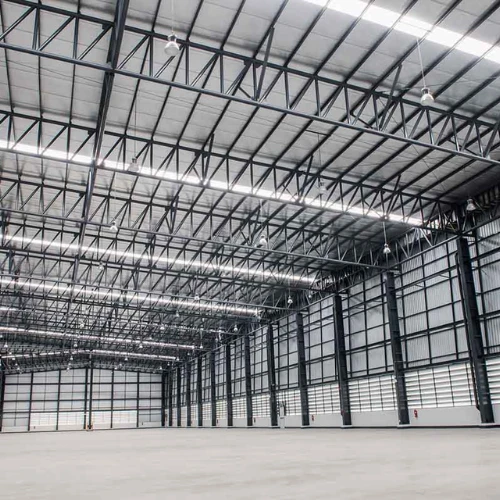
An industrial crane isn’t just a piece of equipment bolted into your building. It interacts directly with your structure’s columns, roof trusses, and foundation. A crane sized for your current needs but not your future ones can limit expansion. A crane sized for occasional heavy lifts but specified for constant use will wear out faster and create safety risks over time.
Getting the selection right at the start saves money on both the crane itself and the structural design needed to support it, which is why crane selection and building design usually happen together rather than as separate decisions.
Types of Industrial Cranes Used in Warehouses and Factories
Overhead (Bridge) Cranes
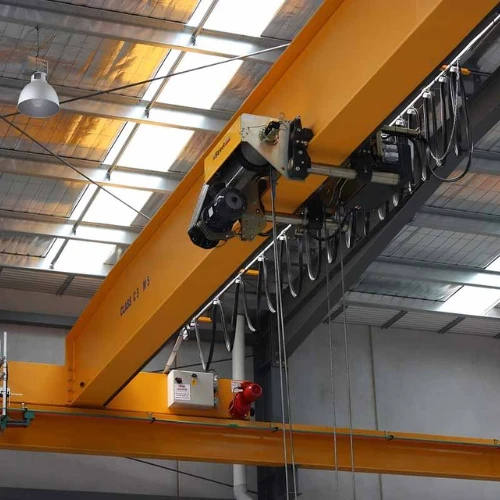
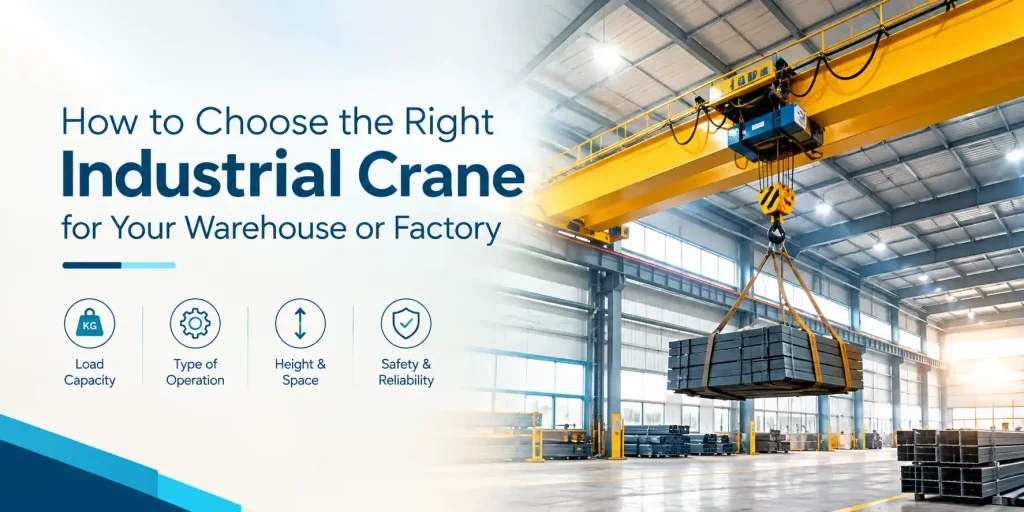
Overhead cranes, also called bridge cranes, run on rails mounted along the length of the building, moving loads across the full floor area below. They are the most common choice for warehouses and manufacturing facilities that need to move heavy materials across a wide working area.
Underhung Cranes
An underhung crane’s bridge hangs from the building’s roof structure rather than running on top of dedicated rails. This design suits facilities where headroom is limited or where the structure isn’t built to carry the additional load of a top-running system.
Jib Cranes
Jib cranes rotate around a fixed vertical column or wall mount, covering a circular work area rather than the full length of a building. They are well suited to individual workstations, loading bays, or areas where lifting needs are localized rather than building-wide.
Monorail Cranes
Monorail cranes run along a single fixed rail, typically used for repetitive point-to-point movement, such as moving parts along a production line.
Gantry Cranes
Gantry cranes are supported by their own legs running on ground-level rails rather than being mounted to the building structure, making them useful for outdoor yards or facilities where overhead mounting isn’t practical.
Each of these serves a different layout and workflow, which is why the right type depends on how materials actually move through your facility, not just on the load being lifted.
Key Factors to Consider When Choosing an Industrial Crane
Load Capacity
This is the most obvious factor, but it’s worth planning for actual working loads and occasional peak loads separately, rather than sizing the crane only for your heaviest possible lift. Overspecifying capacity adds unnecessary cost, while underspecifying it creates safety and productivity problems.
Span and Building Dimensions
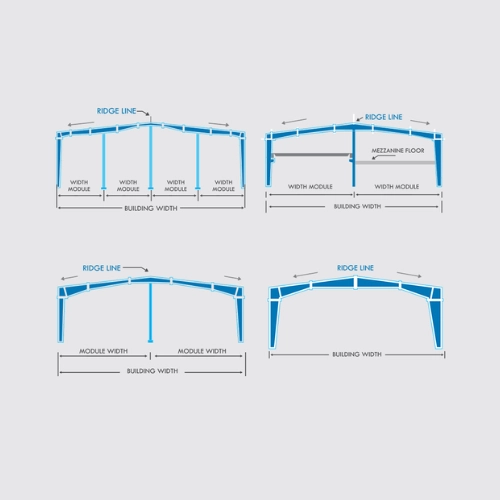
The crane’s span is tied directly to your building’s width and column spacing. A wider clear span without intermediate columns gives more usable floor space but requires stronger structural design to support the crane runway. This is one of several reasons crane requirements should be finalized alongside your building’s structural design, not after it.
Duty Class and Usage Frequency
Duty class reflects how intensively a crane will be used: the number of lifts per hour, operating hours per day, and the mix of light, medium, and maximum loads over its working life. A crane used occasionally for general handling has very different requirements than one running continuously in a production environment, even if both need to lift the same maximum weight.
Single Girder vs Double Girder
Single girder cranes use one bridge beam, with the hoist trolley running along its lower flange. They’re generally more cost-effective, easier to install, and well suited to light and medium loads with moderate spans.
Double girder cranes use two bridge beams with the trolley running on top and are built for heavier loads, longer spans, higher duty classes, and greater hook height. They cost more and need stronger structural support, but outperform single-girder cranes in demanding, high-frequency operations.
As a general rule, choose a single girder crane unless your load, span, or duty class specifically calls for a double girder system.
Lifting Height (Hook Height)
The vertical distance the hook needs to travel, from the floor to its highest working point, affects both crane design and your building’s eave height. This is easy to overlook early on but expensive to correct later.
Safety Features
Overload protection, emergency stop systems, and anti-collision features aren’t optional extras for industrial use. They directly affect both worker safety and how much unplanned downtime you can expect over the crane’s lifespan.
Integration with Your Building Structure
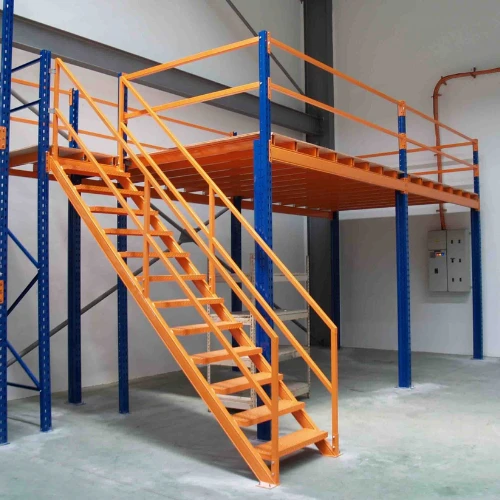
A crane that isn’t designed alongside your building’s steel structure can create conflicts with columns, roof bracing, or mezzanine clearances discovered only after installation begins. Cranes designed as part of your building’s overall structural plan avoid this problem entirely.
Common Mistakes to Avoid When Selecting an Industrial Crane
- Choosing based on price alone, without accounting for duty class and expected usage, which often leads to premature wear or frequent breakdowns
- Underestimating future needs, resulting in a crane and building structure that can’t accommodate business growth without a costly retrofit
- Treating crane selection as separate from building design, which can create structural conflicts that are far more expensive to fix after construction than to plan for upfront
- Overlooking hook height requirements, only to find the crane can’t reach the working height needed once installed
How Choice Pre-Fab Helps You Choose the Right Crane
As an in-house PEB manufacturer, we design crane systems alongside your building’s structure rather than as an afterthought. This means your crane’s span, load path, and column requirements are accounted for from the earliest design stage, not retrofitted once the building is already planned.
We manufacture a range of industrial cranes, including overhead cranes, underhung cranes, jib cranes, and monorail systems, each built to the load capacity, span, and duty class your operation actually needs. Explore our full range of crane systems or see how we approach structural design for the buildings that support them.
Frequently Asked Questions
What type of industrial crane is best for a warehouse?
For most warehouses, an overhead (bridge) crane offers the best balance of coverage and capacity, since it can move loads across the full floor area. Jib or monorail cranes suit facilities with more localized lifting needs.
How do I know what load capacity I need?
Base your load capacity on your actual heaviest routine lift, with some allowance for occasional peak loads, rather than sizing the crane for a rare worst-case scenario. Your crane manufacturer can help calculate this based on your operations.
Should I choose a single-girder or double-girder crane?
Single girder cranes suit light to medium loads and moderate spans at a lower cost. Double girder cranes are better suited to heavier loads, longer spans, and high-frequency use. Your specific load, span, and duty class should guide this decision.
Can an industrial crane be added to an existing building?
Yes, but the existing structure needs to be assessed to confirm it can support the additional load. In some cases, structural reinforcement is required before a crane can be safely installed.
How does crane selection affect building design?
Crane span, load, and duty class directly influence column spacing, roof bracing, and overall structural design. This is why crane requirements are best finalized alongside your building’s design rather than after construction.