Material handling plays a vital role in improving productivity, safety, and operational efficiency across industries. Whether you operate a manufacturing plant, warehouse, engineering workshop, or construction site, selecting the right crane system can significantly impact your workflow and long-term operating costs. Among the most commonly used industrial lifting solutions are Bridge Crane vs Gantry Crane. While both are designed to lift and move heavy loads, they differ in structure, installation, mobility, and applications. Understanding these differences will help you choose the right crane system based on your operational needs.
At Choice Prefab, we specialise in designing and manufacturing customised industrial crane systems for businesses across Ahmedabad, Gujarat, and throughout India. As a trusted Bridge Crane Manufacturer, we help industries select lifting solutions that maximise efficiency while maintaining the highest safety standards.
In this guide, we’ll compare bridge cranes and gantry cranes, explain their key features, and help you determine which system is the best fit for your industry.
What Is a Bridge Crane?
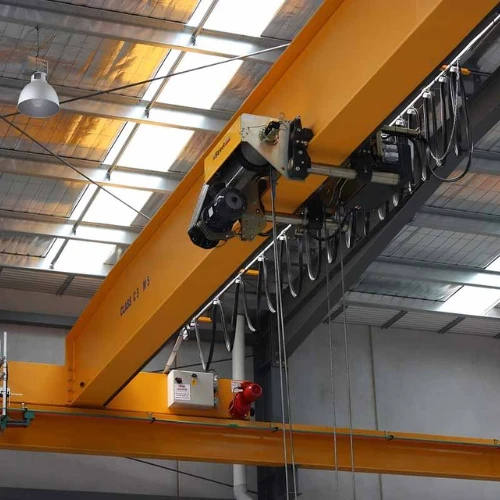
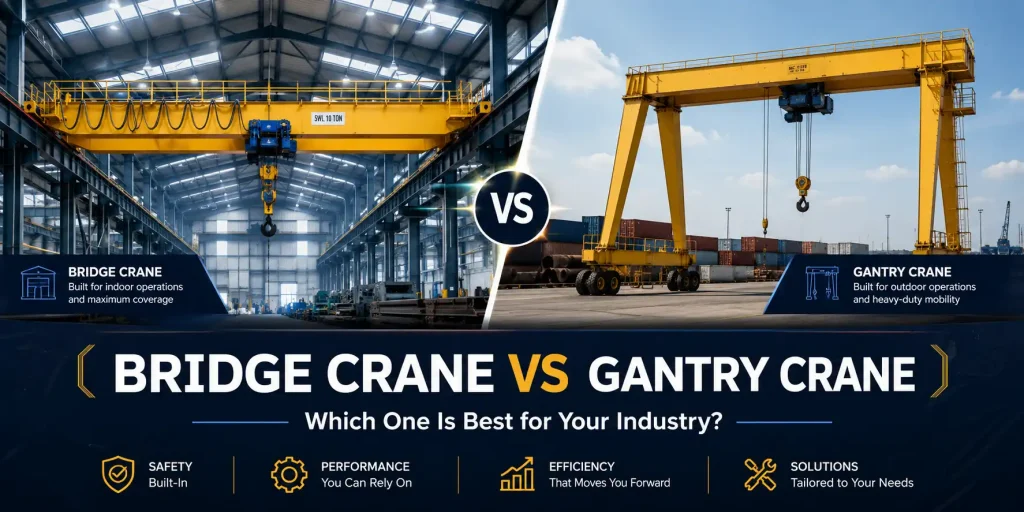
A bridge crane is an overhead material handling system that operates on elevated runway beams attached to a building’s structure. It consists of a bridge girder, trolley, hoist, and end trucks, allowing materials to move horizontally and vertically with precision.
Bridge cranes are widely used in factories, warehouses, automotive plants, engineering industries, and manufacturing units where continuous lifting operations are required.
Key Features of Bridge Cranes
- Mounted on overhead runway beams
- Maximises usable floor space
- High lifting capacity
- Smooth and precise load handling
- Suitable for continuous industrial operations
- Available in single girder and double girder designs
Because the crane travels above the workspace, it allows workers and machinery to move freely below, making it an ideal solution for facilities with limited floor space.
What Is a Gantry Crane?
A gantry crane is a lifting system that uses freestanding legs to support the bridge structure. Instead of relying on a building’s framework, the crane moves on wheels or rails installed at ground level.
Gantry cranes are commonly used for outdoor applications where installing overhead runway beams is impractical. Industries such as construction, shipbuilding, infrastructure development, and heavy fabrication frequently use gantry cranes.
Key Features of Gantry Cranes
- Freestanding support structure
- Suitable for indoor and outdoor applications
- Easy installation without modifying the building
- Portable or rail-mounted options available
- Ideal for moving oversized equipment and heavy materials
Their flexibility makes them an excellent choice for projects that require temporary or mobile lifting solutions.
Bridge Crane vs Gantry Crane – Key Differences
Although both crane systems perform similar lifting functions, they are designed for different operational environments.
| Feature | Bridge Crane | Gantry Crane |
| Structure | Mounted on building runways | Supported by freestanding legs |
| Installation | Requires building support | No building support required |
| Best Location | Indoor facilities | Indoor & outdoor applications |
| Floor Space | Keeps floor area clear | Legs occupy floor space |
| Mobility | Fixed system | Portable or rail-mounted |
| Maintenance | Lower exposure to weather | Outdoor maintenance may be required |
The choice between the two depends on factors such as available space, production requirements, lifting capacity, and budget.
Advantages of Bridge Cranes
For manufacturing plants and warehouses, bridge cranes are often the preferred solution because they provide efficient material handling without taking up valuable floor space.
Better Space Utilisation
Since the crane travels overhead, production equipment, storage racks, and workers can utilise the floor without obstruction. This improves workflow and creates a safer working environment.
Higher Productivity
Bridge cranes allow materials to be transported quickly between different workstations. This reduces downtime and speeds up production processes.
Increased Workplace Safety
Heavy manual lifting can lead to workplace injuries and damaged products. Bridge cranes minimise these risks by providing controlled and precise lifting operations.
Long-Term Cost Savings
Although the initial investment may be higher than some lifting systems, bridge cranes require less manual labor, reduce material damage, and improve operational efficiency, resulting in long-term savings.
Advantages of Gantry Cranes
Gantry cranes offer several benefits, particularly for outdoor projects and facilities that cannot accommodate overhead runway systems.
Easy Installation
Since they do not rely on the building structure, gantry cranes can be installed quickly with minimal structural modifications.
Excellent Mobility
Portable gantry cranes can be moved between work areas, making them ideal for changing project requirements.
Suitable for Outdoor Operations
Unlike bridge cranes, gantry cranes perform efficiently in open environments such as shipping yards, construction sites, and infrastructure projects.
Cost-Effective for Temporary Projects
Businesses working on short-term or outdoor projects often prefer gantry cranes because of their flexibility and ease of relocation.
Which Crane Is Better for Your Industry?
The answer depends entirely on your operational requirements.
A bridge crane is generally the better choice if you have a permanent manufacturing facility, require frequent lifting operations, and want to maximise floor space. It is particularly suitable for warehouses, engineering workshops, automotive plants, steel fabrication units, and manufacturing industries.
On the other hand, a gantry crane is ideal if your operations take place outdoors, your project requires mobility, or your facility cannot support overhead runway beams. Construction companies, infrastructure projects, shipyards, and fabrication yards often benefit from gantry crane systems.
Rather than choosing based on cost alone, businesses should evaluate lifting capacity, operational frequency, workspace, and future expansion plans before investing in a crane system.
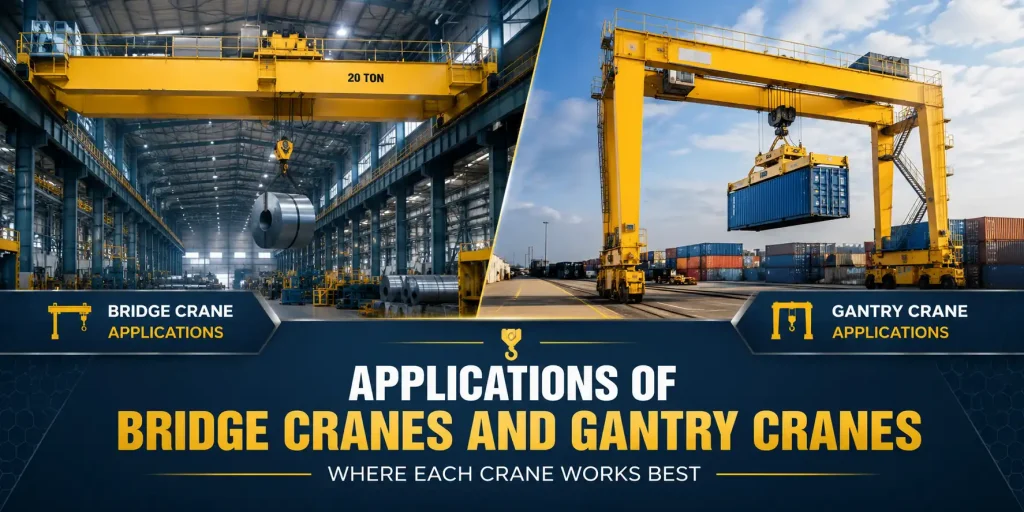
Applications of Bridge Cranes and Gantry Cranes
Both bridge cranes and gantry cranes are widely used across industries, but each serves different operational needs.
Industries That Use Bridge Cranes
Bridge cranes are ideal for permanent indoor facilities where materials need to be moved efficiently between production areas.
Common applications include:
- Manufacturing plants
- Automobile industries
- Steel fabrication units
- Engineering workshops
- Warehouses
- Logistics centers
- Pharmaceutical industries
- Food processing plants
These industries benefit from bridge cranes because they provide smooth, accurate, and continuous material handling while maximising floor space.
Industries That Use Gantry Cranes
Gantry cranes are commonly used in environments where overhead runway systems are not practical.
Typical applications include:
- Construction sites
- Infrastructure projects
- Shipping yards
- Railway workshops
- Container handling
- Heavy fabrication yards
- Outdoor storage facilities
- Power plant construction
Their freestanding structure makes them highly versatile for outdoor and temporary operations.
How to Choose the Right Crane for Your Business
Selecting the right crane requires careful evaluation of your operational requirements. Consider the following factors before making your decision:
Lifting Capacity
Determine the maximum weight your crane will need to handle. Choosing the right capacity ensures safe and efficient operations.
Workspace Layout
If your facility has sufficient overhead support, a bridge crane is often the most efficient choice. For open yards or temporary locations, a gantry crane may be more suitable.
Frequency of Use
For continuous daily operations, bridge cranes generally offer better long-term performance. Gantry cranes are ideal for occasional or project-based lifting.
Budget and Future Expansion
Consider not only the initial investment but also maintenance, operational costs, and future production growth.
Safety Requirements
Choose a crane system that complies with industrial safety standards and provides reliable performance under your operating conditions.
Consulting an experienced Bridge Crane Manufacturer can help you select a solution that matches your current needs while supporting future expansion.
Why Choose Choice Prefab for Industrial Crane Solutions?
When investing in a crane system, partnering with the right manufacturer is just as important as selecting the right equipment.
At Choice Prefab, we design and manufacture industrial crane systems that deliver reliability, safety, and long-term value. Our engineering team works closely with clients to understand their lifting requirements and provide customised solutions for a wide range of industries.
Our Advantages
- Customised bridge crane and gantry crane solutions
- High-quality materials and precision manufacturing
- Experienced engineering and design team
- Strict quality control and testing
- Reliable installation guidance
- Responsive after-sales support
Based in Ahmedabad, we proudly serve clients across Gujarat and throughout India, helping industries improve material handling efficiency with dependable crane systems.
Whether you need a bridge crane for a warehouse or a gantry crane for a construction project, Choice Prefab delivers solutions designed to meet your operational goals.
Conclusion
Choosing between a bridge crane and a gantry crane depends on your facility, operational requirements, and long-term business goals. While both systems offer reliable material handling, bridge cranes are ideal for permanent indoor operations where efficiency, safety, and floor space optimisation are priorities. Gantry cranes, on the other hand, provide flexibility for outdoor environments and projects that require mobility.
By understanding the strengths of each system, businesses can make informed decisions that improve productivity and reduce operational costs.
If you’re looking for a trusted Bridge Crane Manufacturer in Ahmedabad, Choice Prefab offers customised industrial crane solutions designed to meet the unique needs of modern industries. Our team is committed to delivering high-quality, durable, and efficient crane systems that support safe and seamless material handling.
Contact Choice Prefab today to discuss your project requirements and discover the right crane solution for your business.
Frequently Asked Questions
Which is better, a bridge crane or a gantry crane?
Neither is universally better. A bridge crane is ideal for permanent indoor facilities, while a gantry crane is better suited for outdoor applications and projects requiring mobility.
What is the main difference between a bridge crane and a gantry crane?
The main difference is structural support. A bridge crane runs on overhead runways attached to the building, whereas a gantry crane is supported by its own legs and moves on ground-level rails or wheels.
Which industries commonly use bridge cranes?
Bridge cranes are widely used in manufacturing plants, warehouses, engineering workshops, automotive industries, steel fabrication units, and logistics centres.
Can bridge cranes be customised?
Yes. Modern bridge cranes can be customised based on lifting capacity, span length, hook height, duty cycle, and specific industrial requirements.
How do I choose the right crane manufacturer?
Look for a manufacturer with proven industry experience, customisation capabilities, quality manufacturing standards, reliable customer support, and successful project experience.